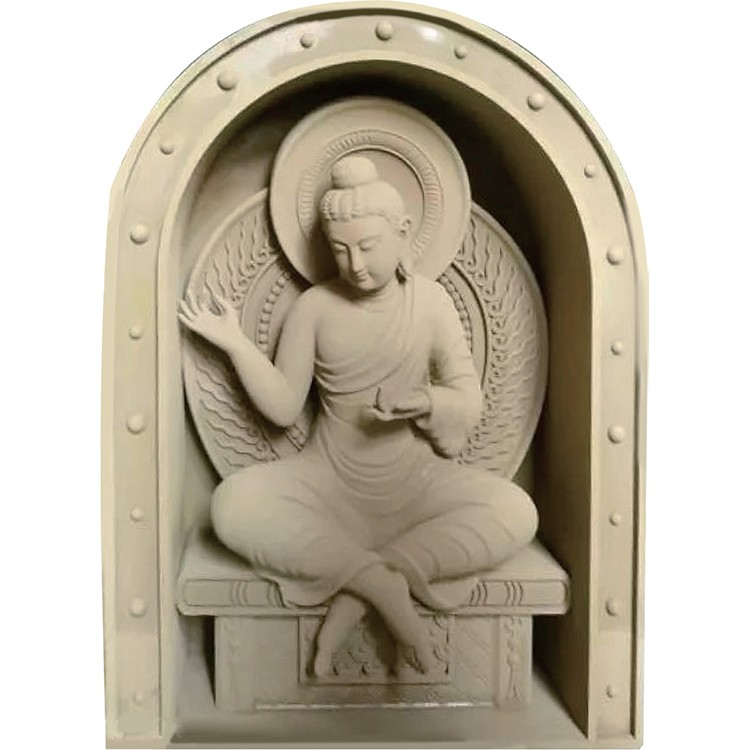
Custom Buddha statue 3D printing service has emerged as a practical option for creating personalized religious art with a high level of detail. Unlike traditional methods that rely on manual carving or mold casting, 3D printing builds objects layer by layer from a digital model. This approach allows for precise control over size, pose, and finish, making it possible to produce statues that meet specific aesthetic or devotional requirements while preserving traditional iconographic features.
What Is a Custom Buddha Statue 3D Printing Service?
How 3D Printing Is Used for Buddha Statues
The process of creating a Buddha statue through 3D printing typically begins with a digital 3D model. This model is sliced into thin cross-sectional layers using software, and then an additive manufacturing machine deposits material layer by layer to form the physical object. After printing, post-processing steps such as sanding, polishing, or coating are applied to achieve the desired surface quality. Custom services allow customers to choose the size, posture, facial expression, and decorative details of the statue, while ensuring that the final piece adheres to conventional Buddhist iconography.
Key Differences from Traditional Manufacturing
Compared with traditional carving or molding, 3D printing offers greater design flexibility. Complex geometries, undercuts, and fine ornamental details that are difficult or impossible to achieve with hand tools or single-piece molds can be produced more easily. Production speed is often faster for small batches or one-off pieces, and material options range from plastics to metals and ceramics. Additionally, 3D printing enables the creation of hollow interiors or internal support structures, which can reduce material usage and weight without compromising external appearance.
3D Printed Buddha Statue: Materials and Technologies
Common Materials for Buddha Statue 3D Printing
A variety of materials can be used for 3D printed Buddha statues, each with distinct characteristics. Resin is popular for its smooth surface and ability to capture fine details, making it suitable for small decorative pieces. PLA and nylon are common thermoplastics that offer durability and ease of printing. For a more traditional look, metals such as bronze or brass can be printed using direct metal laser sintering, providing a metallic finish that resembles cast statues. Ceramic is another option, valued for its natural texture and durability, which aligns well with the aesthetic of many religious sculptures.
Ceramic 3D Printing Service: Process and Capabilities
Ceramic 3D printing typically involves binder jetting or extrusion of a ceramic slurry, followed by a sintering process to densify the material. In binder jetting, a liquid binder is selectively deposited onto a powder bed, layer by layer, to create a green part that is later fired in a kiln. The mesh size of the ceramic powder influences the surface finish and the level of detail that can be resolved; finer powders generally allow for smoother surfaces and sharper features. Ceramic 3D printing is capable of producing statues of considerable size, though large pieces may require sectioning and assembly after firing.
Custom Statue 3D Printing: From 3D Model to Finished Piece
Creating a Buddha Statue 3D Model
Obtaining a suitable 3D model is a critical first step in custom statue 3D printing. Options include commissioning a designer to create a model from scratch, using a 3D scanner to digitize an existing statue, or modifying a pre-existing digital model that is available from online libraries or service providers. High-resolution models are essential for capturing intricate details such as facial features, hand gestures, and robe folds. When scanning an existing statue, multiple scans may be merged to ensure completeness and accuracy.
Design Considerations for Custom Buddha Statues
Several design factors affect the success of a 3D printed Buddha statue. Size determines whether the piece can be printed in one go or must be divided into sections. Wall thickness must be sufficient to maintain structural integrity, especially for larger statues. Support structures are often required for overhanging features, and these must be designed for easy removal. Orientation during printing influences surface quality and strength, as layers are typically weaker along the build direction. For statues taller than the printer's build volume, sectioning and subsequent assembly with adhesives or mechanical joints are common practices.
Considerations When Choosing a Custom Buddha Statue 3D Printing Service
Quality and Accuracy Factors
The final appearance of a 3D printed Buddha statue depends on several factors, including layer resolution, material purity, and post-processing techniques. A smaller layer height results in smoother surfaces but increases printing time. Material quality affects color consistency, mechanical properties, and long-term stability. Post-processing methods such as sanding, polishing, painting, or applying metallic finishes can significantly enhance the visual result. For religious art, maintaining correct proportions and serene facial expressions is critical, so the accuracy of the digital model and the printing process must be carefully controlled.
Cost, Lead Time, and Logistics
The cost of a custom Buddha statue 3D printing service varies with material, size, complexity, and quantity. Larger statues require more material and longer print times, while intricate designs may need additional supports or post-processing labor. Lead time depends on the printing technology, the need for model preparation, and any curing or sintering steps. For international orders, shipping costs and packaging requirements must be considered, especially for fragile ceramic or metal pieces. It is advisable to discuss all these aspects with the service provider before placing an order.
3D Printing for Religious Art: Cultural and Ethical Perspectives
Respecting Religious Symbolism
Producing religious artifacts such as Buddha statues carries cultural and ethical responsibilities. It is important to approach the creation of such items with sensitivity and respect for Buddhist traditions. Consulting with religious communities or scholars can help ensure that the statue's proportions, hand gestures (mudras), and other iconographic elements are accurate and appropriate. This is especially relevant when the statue is intended for use in a temple or for devotional purposes.
Preservation and Restoration Applications
Beyond new creations, 3D printing is also used for replicas and restoration of damaged Buddha statues. Digital scanning and printing allow for the reproduction of missing parts or the creation of exact replicas for display or study. Digital archiving of statues helps preserve cultural heritage by creating a permanent record that can be used for future restoration or educational purposes. This application demonstrates the broader potential of 3D printing in the field of cultural preservation.
Company Public Information Reference
Example of a 3D Printing Service Provider
As an example of a 3D printing service provider, a company based in Shaoyang City, Hunan Province, China, operates in the field of 3D printing technology. According to publicly available information, its core business includes the research and development, manufacturing, and sales of 3D printing equipment; the research, production, and sales of 3D printing consumables; and the expansion of 3D printing technology applications. The company's main products include sand, metal, ceramic, and graphite 3D printers with supporting consumables such as binders and powders, as well as various 3D printed parts and overall 3D printing solutions for specific industries. It has established a 3D printing industrialization base in Shaoyang City, with a production workshop of approximately 3,000 square meters, used for equipment manufacturing, consumable production, and 3D printing services.
Example of a 3D Printed Ceramic Buddha Statue
As a reference, the same company has produced a 3D printed ceramic Buddha statue with dimensions of 1000*600*500mm, using 150-mesh ceramic powder and a gold effect finish. This example illustrates the technical feasibility of large-scale ceramic 3D printing for religious art. It shows that with appropriate equipment and materials, it is possible to create substantial and aesthetically finished statues. For more details, you can view the Buddha Statue product page.
Conclusion
In summary, custom Buddha statue 3D printing service offers a flexible and precise method for creating personalized religious art. Materials such as ceramic provide a natural and durable finish, while digital modeling allows for exact replication of traditional iconography. When choosing a service, it is important to evaluate material options, design requirements, and cultural considerations. For specific projects, consulting with qualified professionals can help ensure the best outcome.