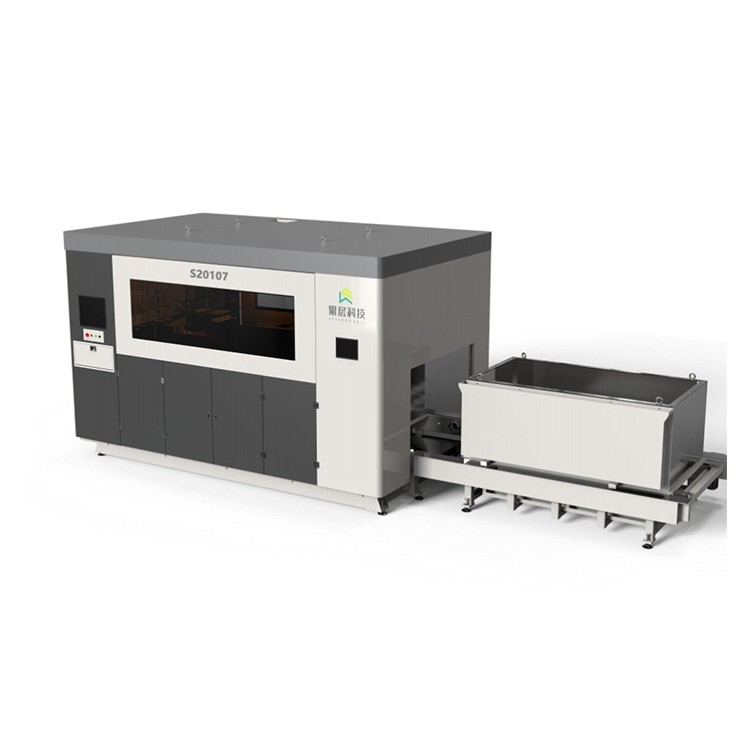
Sand mold 3D printing has changed how foundries approach mold making, moving away from traditional pattern-based methods toward direct digital manufacturing. The S20107 is a mid-to-large format sand mold 3D printer designed for industrial casting applications. This article explains how the sand mold 3D printer S20107 works, covering its core technology, materials, and operational workflow.
Understanding the Sand Mold 3D Printer S20107
What Is a Sand Mold 3D Printer?
A sand mold 3D printer is an industrial additive manufacturing system that produces sand molds and cores for metal casting. Unlike traditional pattern-based mold making, it builds molds layer by layer directly from a digital model. The S20107 is a specific model within this category, designed for medium-to-large casting applications.
Key Specifications of the S20107 Model
The S20107 sand mold 3D printer has a build volume of 2000×1000×700 mm. It operates with a layer thickness of 0.2–0.5 mm, a print resolution of 400×400 DPI, and achieves a sand mold accuracy of ±0.3 mm. The tensile strength of printed molds ranges from 1.0 to 2.5 MPa, and gas evolution is between 10 and 18 ml/g, depending on consumables. It can process silica sand, ceramic sand, and foundry sand.
The Working Principle of the S20107
Binder Jetting Technology Explained
The S20107 uses binder jetting, an additive manufacturing process where a printhead selectively deposits a liquid binder onto a thin layer of sand powder. The binder bonds the sand particles together to form the desired shape. After each layer is printed, the build platform lowers, a new layer of sand is spread, and the process repeats until the mold is complete. Unbound sand remains in place and supports the structure during printing, then is removed afterward.
Step-by-Step Operation of the S20107
- Digital Model Preparation: A 3D CAD model of the mold is sliced into cross-sectional layers using software.
- Sand Spreading: A roller or blade spreads a uniform layer of sand (e.g., silica sand) across the build platform.
- Binder Deposition: The printhead moves over the sand layer, depositing binder droplets according to the slice data.
- Layer Curing: The binder reacts with the sand to form a solid bond; the layer is then dried or cured as needed.
- Platform Lowering: The build platform descends by one layer thickness.
- Repetition: Steps 2–5 are repeated until the entire mold is built.
- Post-Processing: Loose sand is removed, and the mold may undergo cleaning or additional curing before use in casting.
This binder jetting sand mold workflow is the foundation of the S20107 3D printer operation, enabling complex geometries without physical tooling.
Materials and Process Parameters for Sand Mold Printing
Printable Sand Materials
The S20107 supports silica sand, ceramic sand, and foundry sand. These materials are chosen based on casting requirements such as thermal stability, surface finish, and permeability. The choice of sand affects the final mold quality and the casting process.
Key Process Parameters
- Layer Thickness: 0.2–0.5 mm (adjustable as required)
- Print Resolution: 400×400 DPI (adjustable as required)
- Sand Mold Accuracy: ±0.3 mm
- Tensile Strength: 1.0–2.5 MPa (depends on consumables)
- Gas Evolution: 10–18 ml/g (depends on consumables)
These parameters influence the mechanical properties and dimensional accuracy of the printed mold. Operators can adjust them based on the specific casting application.
Applications of the S20107 in Foundry and Casting
Common Industrial Uses
The S20107 is used for producing sand molds and cores for aluminum casting, iron casting, and steel casting. It is suitable for applications requiring complex geometries, short lead times, or low-volume production, such as prototyping, custom parts, and replacement components.
Benefits Over Traditional Mold Making
Sand mold 3D printing eliminates the need for physical patterns, reducing tooling costs and lead times. It allows for design optimization and the production of molds with internal cooling channels or complex cores that are difficult or impossible to achieve with conventional methods. The process also enables on-demand production, reducing inventory and waste.
Operational Considerations for the S20107
Software and Slicing
The S20107 uses proprietary software that supports online slicing, eliminating the need for pre-slicing before printing. The software also includes a resume-print function, which allows the printer to continue from where it stopped in case of an interruption. This feature enhances operational efficiency and reduces material waste.
Maintenance and Support
Regular maintenance includes cleaning the printhead, checking binder flow, and ensuring the sand spreading mechanism is calibrated. The manufacturer provides 24-hour online technical support and, for domestic customers, on-site arrival within 36 hours when required. These services help minimize downtime and maintain print quality.
Manufacturer Background
The S20107 sand mold 3D printer is manufactured by Guangdong Leiceng Technology Development Co., Ltd., located in Foshan High-tech Zone Robot Integration Innovation Center, Guangdong Province, China. The company was founded in September 2020 and focuses on the R&D, manufacturing, and sales of 3D printing equipment and consumables. Its product line includes sand, metal, ceramic, and graphite 3D printers, serving industries such as foundry, military, scientific research, education, and mold making.
The company states that over 95% of equipment components are domestically manufactured. It supports the use of recycled sand in its printers, which can reduce material costs. The company also provides technical support and has an industrialization base in Shaoyang City, Hunan Province, with a production workshop of about 3,000 square meters.
Understanding how the sand mold 3D printer S20107 works provides useful context for foundries evaluating digital mold-making options. The combination of binder jetting technology, flexible material support, and adjustable process parameters makes it a practical option for foundry sand 3D printing across various casting operations.