1. Overview of Binder Jetting Sand Printing
1.1 What Is Binder Jetting in Sand Mold 3D Printing?
Binder jetting is an additive manufacturing process in which a liquid binding agent is selectively deposited onto a bed of powdered material. In sand mold 3D printing, the powder is typically a foundry-grade sand, and the binder bonds sand grains together layer by layer. A printhead moves across the build area and deposits binder droplets only in the regions that correspond to the cross-section of the desired part. After each layer is printed, a fresh layer of sand is spread across the build surface, and the process repeats until the entire mold or core is formed within the sand bed. The unbound sand surrounding the printed geometry remains loose and serves as natural support during the build, which allows for complex cavity shapes and undercuts that would be difficult or impossible to achieve with conventional pattern-based methods.
1.2 Key Components of a Sand Mold 3D Printer
A sand mold 3D printer generally comprises several subsystems that work together to ensure consistent layer formation and accurate binder placement. These include a build platform or job box that holds the sand bed, a recoater or sand spreading mechanism that distributes uniform layers of sand, a printhead assembly with one or more nozzle arrays for binder deposition, a binder supply and delivery system, and a control system that coordinates motion, layer thickness, and print data. Additional components may include sand conditioning or mixing equipment, sensors for monitoring layer quality, and software for slicing digital models into printable layers. The interaction of these components determines the achievable resolution, dimensional accuracy, and mechanical properties of the printed sand mold.
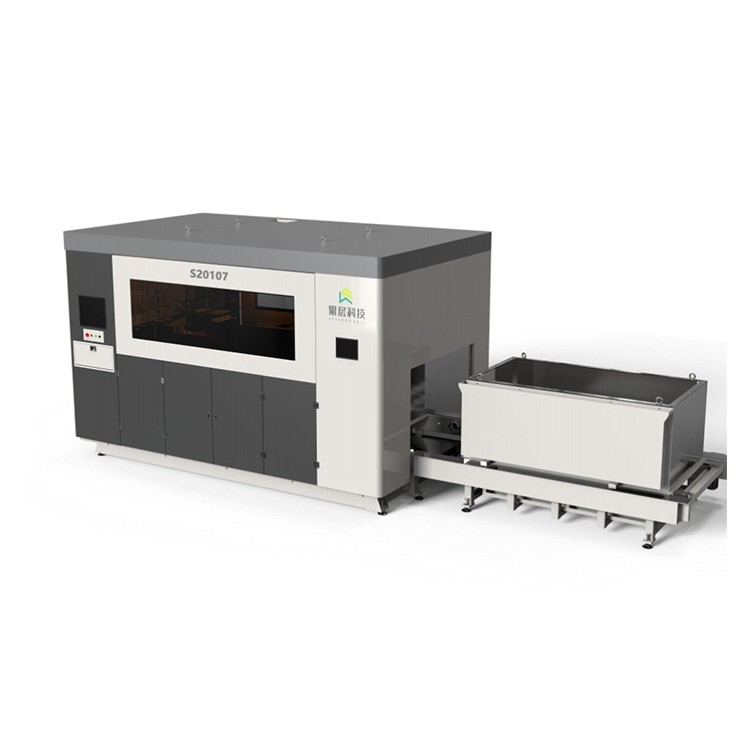
2. Step-by-Step Workflow of the S20107 Sand Mold 3D Printer
2.1 Build Volume and Layer Thickness Specifications
The S20107 is part of a sand mold 3D printer series that includes models such as the S301510, S251510, S20107 (High/Low), S12105, and S654, with build volumes ranging from 600×500×400 mm to 2500×1500×1000 mm. For the S20107 specifically, the relevant process specifications include a layer thickness range of 0.2 to 0.5 mm, a print resolution of 400×400 DPI, sand mold accuracy of ±0.3 mm, tensile strength of 1.0 to 2.5 MPa, and gas evolution of 10 to 18 ml/g. These parameters provide a framework for understanding the machine's capability envelope and help foundries plan job layouts and post-processing steps accordingly. The layer thickness selection within the 0.2 to 0.5 mm range influences both build time and surface finish, with thinner layers generally improving resolution at the cost of longer print durations.
2.2 Printing Process: From Sand Spreading to Binder Jetting
The printing process begins with the preparation of a digital model, which is sliced into thin cross-sectional layers using specialized software. The sliced data is sent to the printer, and the build platform is positioned at the starting height. A recoater spreads a uniform layer of sand across the build area, and the printhead passes over the sand bed to deposit binder in the pattern of the first cross-section. Once the layer is complete, the build platform lowers by one layer thickness, and the sequence repeats: sand spreading, binder jetting, and platform descent. This cycle continues until all layers have been printed and the complete mold or core is embedded in the sand bed. The precision of the recoater and the consistency of binder droplet formation are critical to maintaining dimensional accuracy throughout the build.
3. Post-Processing and Foundry Workflow Integration
3.1 Cleaning and Curing of Printed Sand Molds
After printing is complete, the job box is removed from the printer and the printed mold or core is extracted from the surrounding loose sand. Excess sand is removed, typically using brushes, air blasting, or gentle vibration, taking care not to damage delicate features. The printed part may then undergo a curing step to allow the binder to reach full strength; curing conditions depend on the binder chemistry and may involve controlled heating or ambient curing for a specified period. Once cured, the mold or core can be assembled with other components, coated if required, and prepared for the casting operation. Proper cleaning and curing are essential to avoid defects such as sand inclusion or dimensional distortion during pouring.
3.2 Applications in Aluminum, Iron, and Steel Casting
Sand molds produced by binder jetting are used in a range of foundry applications, including aluminum casting, iron casting, steel casting, and the production of casting sand molds and castings. The ability to print complex geometries without patterns makes the process suitable for prototypes, small series production, and parts with intricate internal channels or cooling passages. In aluminum casting, the lower pouring temperatures and different thermal expansion behavior of the metal may influence mold design considerations, while iron and steel casting involve higher temperatures and place greater demands on mold strength and gas evolution characteristics. Foundries integrating sand mold 3D printing typically evaluate the printed mold properties against the requirements of the specific alloy and casting process.
4. Material and Performance Considerations
4.1 Printable Materials and Their Properties
The S20107 sand mold 3D printer is compatible with printable materials that include silica sand, ceramic sand, and foundry sand. Each material type offers different characteristics relevant to casting performance. Silica sand is widely used in foundry applications and provides a balance of cost and thermal properties. Ceramic sand may offer advantages in terms of thermal stability and surface finish for certain casting conditions. Foundry sand, as a general category, encompasses sands that have been selected or processed for casting use. The specified tensile strength range of 1.0 to 2.5 MPa and gas evolution range of 10 to 18 ml/g provide an indication of the mechanical and thermal behavior of printed molds, which are important factors in mold design and casting process control.
4.2 Factors Affecting Sand Mold Accuracy and Strength
Several factors influence the accuracy and strength of printed sand molds. Layer thickness affects resolution and surface finish, with thinner layers generally yielding finer detail. Binder saturation level and droplet uniformity influence the strength of the bonds between sand grains. Sand particle size distribution and morphology affect both the flowability of the sand during recoating and the final surface quality of the mold. Environmental conditions such as temperature and humidity can impact binder behavior and sand flow. Additionally, the curing process and the handling of the printed mold before and after curing can affect final dimensional accuracy. Foundries typically establish process windows for these variables to achieve consistent results.
5. Industry Experience and Public Reference
5.1 Public Information on Sand Mold 3D Printing Equipment
Publicly available information about sand mold 3D printing equipment and its integration into foundry workflows can serve as a useful reference for those evaluating the technology. The team behind this equipment has nearly a decade of experience in sand mold 3D printing, with expertise in sand printing equipment, casting processes, and their integration. Main products include sand, metal, ceramic, and graphite 3D printers with supporting consumables such as binders and powders, various 3D printed parts, and overall 3D printing solutions for specific industries. These public reference points may assist readers in understanding the broader context of sand mold 3D printing equipment and its role in modern foundry operations. Readers are encouraged to consult verifiable public materials and qualified professionals when making equipment or process decisions.
6. Conclusion
Understanding how the sand mold 3D printer S20107 works involves recognizing the general principles of binder jetting, the specific workflow steps from sand spreading to binder deposition, and the post-processing and material considerations that influence final mold quality. The S20107 operates within a series of sand mold 3D printers with defined specifications for layer thickness, resolution, accuracy, tensile strength, and gas evolution, and it supports materials such as silica sand, ceramic sand, and foundry sand. As foundries continue to adopt additive manufacturing for mold and core production, the binder jetting sand printing process offers a patternless route to complex geometries for aluminum, iron, and steel casting applications. Those considering the technology should evaluate their specific casting requirements and consult qualified professionals for guidance tailored to their operations.