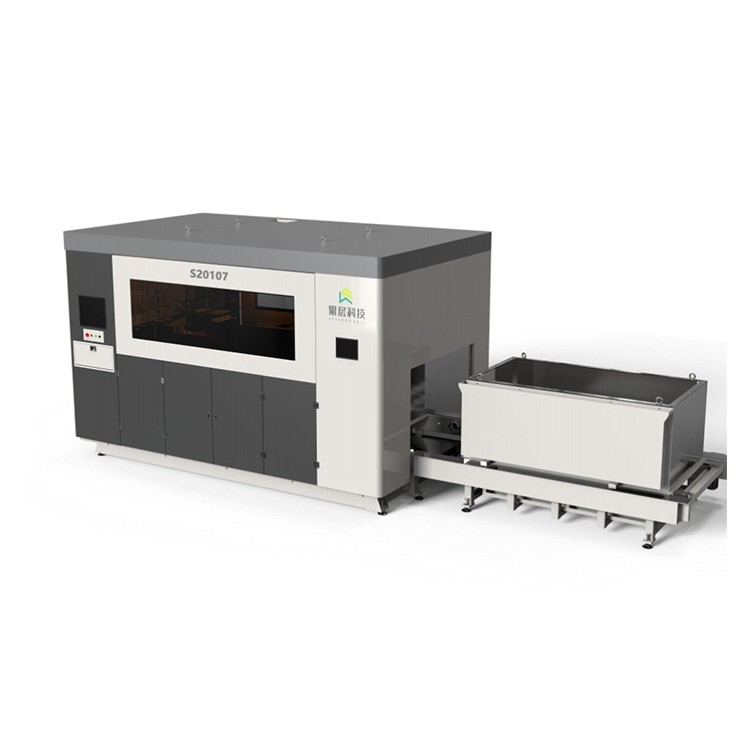
Sand mold 3D printing is transforming how metal casting prototypes and low-volume production parts are made. Instead of machining a physical pattern or tooling, this process builds molds and cores directly from digital data. For anyone asking how does a sand mold 3D printer work for casting, the answer lies in a layer-by-layer additive process that eliminates many traditional constraints. This article explains the working principle, key parameters, operational steps, and typical applications of this technology.
The Basic Working Principle of a Sand Mold 3D Printer
Binder Jetting: The Core Technology
The majority of sand mold 3D printers operate on a principle known as binder jetting. In this process, a print head selectively deposits a liquid binder onto a thin layer of sand. The binder acts as an adhesive, bonding sand particles together in the specific pattern defined by the digital model. The process is repeated layer by layer: a recoater blade spreads a fresh, uniform layer of sand across the build platform, the print head then applies binder according to the cross-sectional slice data, and the platform lowers slightly to accommodate the next layer. This cycle continues until the complete mold or core is formed. Once printing is finished, the unbound, loose sand is removed, typically by vacuuming or brushing, revealing the solid sand structure.
From Digital Model to Physical Mold
The workflow begins with a 3D CAD model of the mold, which includes the cavity, gating system, and risers. This digital file is then sliced into thin, two-dimensional cross-sections by the printer's software. The printer uses these slices as a blueprint, depositing binder only where solid material is required. A key distinction from conventional mold-making is that no physical pattern or tooling is needed. This means design changes can be implemented directly in the CAD file and printed immediately, without the time and cost associated with modifying or creating new tooling.
Key Parameters and Materials in the Sand Mold 3D Printing Process
Layer Thickness, Resolution, and Accuracy
The quality of a 3D printed sand mold is governed by several key parameters. Typical layer thickness ranges from 0.2 to 0.5 mm, which directly influences the surface finish and the level of detail that can be reproduced. Print resolution, often around 400×400 DPI, determines the precision of the binder deposition in the horizontal plane. Dimensional accuracy for this process is generally within ±0.3 mm. These factors combine to determine how faithfully the final mold matches the digital design, affecting both the surface quality of the casting and the precision of its dimensions.
Sand Types and Mechanical Properties
A variety of sand types can be used in this process, including silica sand, ceramic sand, and specialized foundry sands. The choice of sand affects the thermal and mechanical properties of the final mold. For instance, the tensile strength of the printed mold typically falls in the range of 1.0 to 2.5 MPa, which is sufficient to withstand the forces of metal pouring. Another important property is gas evolution, usually between 10 and 18 ml/g, which indicates how much gas the sand will release when exposed to molten metal. Lower gas evolution is generally preferred to reduce the risk of gas porosity defects in the final casting.
Step-by-Step: How a Sand Mold 3D Printer Operates for Casting
Step 1: Preparing the Digital Mold Design
The process starts with designing the mold in CAD software. This includes not only the part geometry but also the gating and riser systems required to guide molten metal into the cavity and compensate for shrinkage. Once the design is complete, the file is converted into a format that the printer's software can interpret, typically an STL file, and then sliced into layers.
Step 2: Printing the Mold Layer by Layer
With the digital file prepared, the printing cycle begins. The machine automatically spreads a thin layer of sand across the build platform. The print head then moves across the layer, jetting binder onto the sand according to the slice data. In some systems, a curing step may be integrated to strengthen the bond. The platform descends, a new layer of sand is spread, and the process repeats. After the initial setup, the printing process is fully automated and can run unattended until the job is complete.
Step 3: Post-Processing and Assembly
After printing is complete, the build box is removed from the printer. The excess, unbound sand is then removed to reveal the finished mold or core. Depending on the application, the mold may be coated with a refractory wash to improve the surface finish of the casting. Finally, cores are placed, and the mold halves are assembled, making it ready for the metal pouring stage. This step is analogous to preparing a conventional sand mold for casting.
Applications of Sand Mold 3D Printing in Metal Casting
The sand mold 3D printing process is used to produce molds and cores for casting a variety of metals, including aluminum, iron, and steel. It is well-suited for both prototyping, where rapid iteration is critical, and low-volume production runs where traditional tooling costs are prohibitive.
Advantages for Complex Geometries
A significant advantage of binder jetting is its ability to create complex geometries that are difficult or impossible to achieve with traditional mold-making methods. This includes intricate internal channels for cooling, complex core designs that would require multiple pieces and assembly, and undercuts that would otherwise need special tooling. By consolidating multiple components into a single printed piece, this technology can reduce assembly steps, improve casting quality, and enable designs that optimize part performance.
Industry Experience and Public Reference Information
Example of a Sand Mold 3D Printer Series
As an example of publicly available information, a company in the sand mold 3D printing industry offers a series of printers with models such as S301510, S251510, S20107, S12105, and S654. According to their published specifications, these machines have a build volume range from 600×500×400 mm up to 2500×1500×1000 mm. Public information also states that the company's team has nearly a decade of experience in the integration of sand mold 3D printing and casting processes. This information is provided as a neutral reference for those researching available equipment.
How to Verify Public Information
Readers interested in specific specifications or capabilities are advised to verify such details by visiting the manufacturer's official website or contacting them directly. This reference is for informational purposes only and does not constitute an endorsement of any particular company or product.
In summary, a sand mold 3D printer works by using binder jetting to selectively bond layers of sand, creating precise molds and cores directly from digital designs. This process offers significant advantages in design freedom, lead time, and complexity for metal casting applications. For specific guidance on adopting this technology, please consult with qualified professionals.