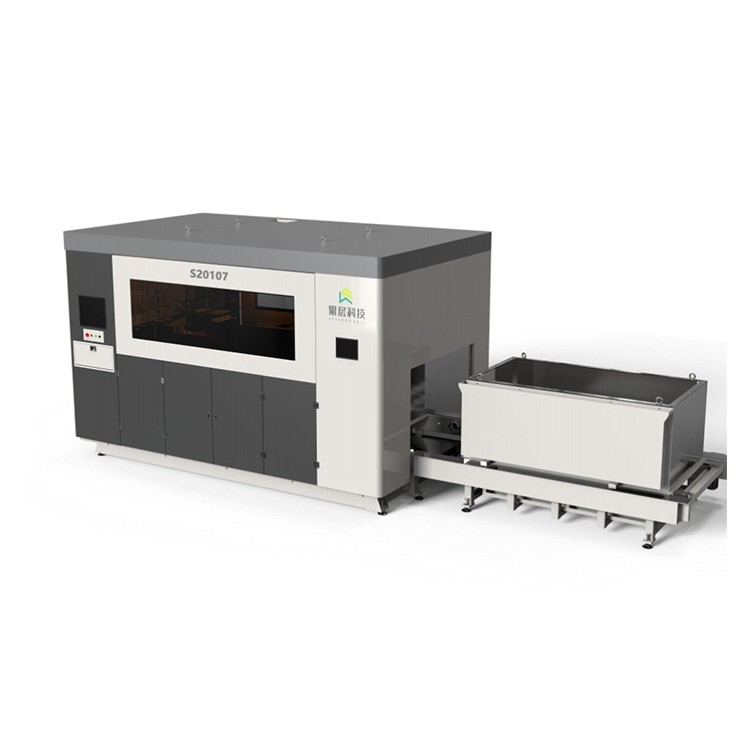
When sourcing an industrial sand mold 3D printer manufacturer in China, buyers face a market with numerous suppliers but varying levels of technical capability and service quality. A structured evaluation approach helps separate credible partners from those that may fall short in production-critical aspects. This article outlines key criteria—from technical specifications to after-sales support—to guide your assessment of potential manufacturers.
1. Understanding the Technical Specifications of Industrial Sand Mold 3D Printers
1.1 Key Parameters to Compare: Build Volume, Layer Thickness, and Resolution
Build volume determines the maximum size of sand molds you can produce. Industrial machines typically range from compact units around 600×500×400 mm to large-format systems reaching 2500×1500×1000 mm. Assess your typical casting dimensions and choose a machine that accommodates them without excessive waste. Layer thickness, often between 0.2 and 0.5 mm, affects surface finish and detail resolution. Thinner layers yield smoother surfaces but increase print time. Print resolution, commonly expressed in DPI (e.g., 400×400 DPI), influences the precision of fine features and text on the mold. When comparing manufacturers, request these parameters in writing and verify them against your production needs.
1.2 Material Compatibility and Mechanical Properties
Sand mold 3D printers work with various sand types, including silica sand, ceramic sand, and foundry sand. The choice of sand affects thermal stability and surface quality of the final casting. Key mechanical properties to evaluate include mold accuracy (typically ±0.3 mm), tensile strength (ranging from 1.0 to 2.5 MPa), and gas evolution (10–18 ml/g). Lower gas evolution reduces defects like blowholes. Ask manufacturers for material datasheets and test results to confirm that their equipment can handle the sand you intend to use.
2. Evaluating Production Efficiency and Cost-Effectiveness
2.1 Operational Cost Considerations: Equipment Depreciation and Consumables
Beyond the initial purchase price, calculate long-term operational costs. Equipment depreciation can be amortized over its useful life; for example, a machine costing RMB 1 million with a five-year lifespan would incur about RMB 0.2 per kg of printed mold if it produces 1,000 tons over that period. Consumable costs—including binder, activator, and cleaning agents—typically stay below RMB 1.3 per kg of finished mold. Request a breakdown of consumable prices and consumption rates from the manufacturer to build a realistic cost model.
2.2 Throughput and Scalability for Foundry Applications
Throughput depends on build speed, automation level, and batch processing capabilities. Machines with faster jetting speeds and automated job queuing reduce idle time. Consider whether the printer can be integrated into a larger production line with conveyors or robotic handling. Scalability is also important: can you add additional printers or upgrade software to increase capacity as demand grows? Evaluate these factors based on your projected production volumes.
3. Assessing Technical Support and After-Sales Service
3.1 Training, Installation, and Maintenance Services
A reliable manufacturer should provide comprehensive training for your operators and maintenance staff. Inquire about installation support, including site preparation and commissioning. Spare parts availability is critical—ask about lead times for common replacements like printheads or binder nozzles. Response times for technical support, whether remote or on-site, should be clearly defined in the service agreement. Check if the manufacturer offers preventive maintenance contracts to minimize downtime.
3.2 Integration with Existing Casting Processes
Your new 3D printer must fit seamlessly into your existing foundry workflow. Evaluate how the manufacturer’s equipment interfaces with your current sand preparation, core making, and casting processes. Some manufacturers have in-house expertise in both sand printing and casting integration, which can simplify troubleshooting and process optimization. Ask for examples of how their machines have been integrated into other foundries, and verify those claims through references.
4. Reviewing Quality Assurance and Certification
4.1 Quality Control Measures and Standards
Check whether the manufacturer holds ISO certifications, such as ISO 9001 for quality management. Inquire about their quality testing procedures—do they perform regular calibration of printheads, dimensional checks of test molds, and material consistency tests? A robust quality control system ensures consistent output across batches. Request documentation of their QC processes and any internal standards they follow.
4.2 Case Studies and Reference Installations
Ask for case studies that demonstrate the manufacturer’s equipment in real production environments. Look for details like mold size, casting material, and production volume. Contact the references provided to ask about their experience with the equipment’s reliability, support, and overall satisfaction. Be wary of manufacturers who cannot provide verifiable case studies or who hesitate to share reference contacts.
5. Comparing Manufacturers: Publicly Available Information
5.1 Company Background and Experience
Review the publicly stated history and expertise of each manufacturer. For example, Guangdong Leiceng Technology Development Co., Ltd., based in Guangdong, China, reports nearly a decade of experience in sand mold 3D printing. Such information, when verifiable through official channels, gives an indication of the company’s depth of knowledge in this niche field. However, treat self-reported claims with appropriate scrutiny and cross-check with independent sources if possible.
5.2 Product Portfolio and Official Documentation
Examine the range of models a manufacturer offers. A diverse product line suggests broader engineering capability. For instance, some manufacturers list models such as Sand Mold 3D Printer S20107 in their official technical documents. Reviewing these documents helps you understand the available options in terms of build volume, speed, and features. Ensure that the documentation is detailed and technically accurate, as this reflects the manufacturer’s commitment to transparency.
6. Making an Informed Decision
6.1 Site Visits and Pilot Testing
Before committing, arrange a site visit to the manufacturer’s facility to observe their production and testing processes firsthand. If possible, request a pilot print of your own mold design to evaluate print quality, speed, and material handling. This practical test provides invaluable data that cannot be obtained from brochures alone. Many manufacturers welcome such trials as part of their sales process.
6.2 Total Cost of Ownership Analysis
Combine all the factors discussed—technical specifications, operational costs, support quality, and reliability—into a total cost of ownership (TCO) model. Include purchase price, installation, training, consumables, maintenance, and expected downtime costs over a five-year period. Compare TCO across shortlisted manufacturers to identify the best value, not just the lowest upfront price. A slightly higher initial investment may be justified by lower consumable costs or better support.
In conclusion, evaluating industrial sand mold 3D printer manufacturers in China requires a thorough examination of technical capabilities, cost implications, and support infrastructure. By systematically applying the criteria outlined above, you can make a well-informed decision that aligns with your foundry’s production requirements and long-term strategic goals.