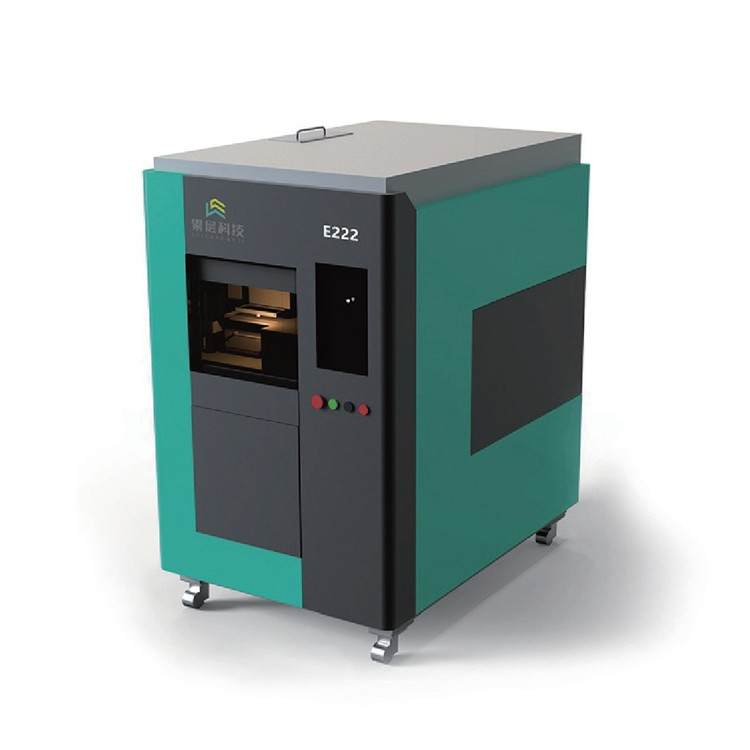
Introduction to the Experimental Educational Printer E222 for University Labs
What Is an Experimental Educational Printer?
An experimental educational printer is a class of additive manufacturing equipment designed for academic and research environments, where the focus is on understanding printing processes, material behavior, and process parameters rather than on production throughput. These printers typically offer a range of adjustable settings and support multiple powder materials, making them suitable for laboratory experimentation. In university settings, such printers serve as platforms for hands-on learning and for investigating the scientific principles behind additive manufacturing.
The Role of the E222 in University 3D Printing Labs
University 3D printing labs use equipment like the E222 to support coursework, student projects, and faculty research. The E222's specifications—such as its build volume, layer thickness, and print resolution—determine the types of experiments and material studies that can be conducted. Its compact footprint and moderate weight make it feasible for installation in shared laboratory spaces. The experimental educational printer E222 for university labs is designed to accommodate a variety of research and teaching activities, from introductory demonstrations to advanced material characterization.
Technical Specifications of the E222 3D Printer
Build Volume and Physical Dimensions
The E222 offers a build volume of 200 × 200 × 200 mm, which is suitable for small-scale test specimens and prototype components. The printer's physical dimensions are 1170 × 755 × 1370 mm, and it weighs 370 kg, requiring adequate floor space and structural support in a laboratory setting. These dimensions make the E222 a mid-sized unit that can fit into standard lab rooms without extensive modifications.
Printing Parameters: Layer Thickness, Speed, and Resolution
The E222 supports a layer thickness range of 0.02 to 0.5 mm, allowing users to adjust the resolution based on the experimental requirements. The print speed is 30 seconds per layer, and the print resolution is 600 × 400 DPI. These parameters influence the surface finish, dimensional accuracy, and overall print time, which are critical variables in material and process research. The ability to vary layer thickness and resolution enables researchers to study how these settings affect the mechanical and physical properties of printed parts.
Supported Powder Materials
The E222 is compatible with a variety of powder materials, including sand, ceramic powder, metal powder, and plastic powder. This versatility enables university labs to explore binder jetting across different material classes without needing multiple dedicated machines. By supporting a broad range of powders, the E222 facilitates comparative studies on material behavior and binder interactions, which are essential for advancing 3D printing material research.
Applications of the E222 in University Research and Education
Material Research and Development
One of the primary applications of the E222 is in 3D printing material research and development, particularly for studying binders and powders. Researchers can use the printer to test new binder formulations, evaluate powder flowability, and analyze the effects of process parameters on final part properties. The adjustable layer thickness and resolution facilitate systematic experimentation. This capability is particularly valuable for university labs that focus on developing novel materials or optimizing existing ones for specific applications.
Process Parameter Studies
University labs often employ the E222 to investigate how variations in layer thickness, print speed, and resolution affect the quality of printed parts. Such studies contribute to the broader knowledge base of binder jetting technology and help students understand the relationships between machine settings and output characteristics. By conducting controlled experiments, students can learn to correlate process parameters with outcomes such as density, strength, and surface roughness.
Educational and Training Use
As an educational tool, the E222 provides hands-on experience with industrial-grade additive manufacturing. Students can learn about the entire workflow—from digital design to post-processing—while gaining familiarity with a technology used in various industries, including foundry, automotive, and aerospace. The printer's user-friendly interface and documentation support its integration into curricula, allowing students to operate the machine safely and effectively.
Binder Jetting 3D Printer for Research: How the E222 Fits In
Overview of Binder Jetting Technology
Binder jetting is an additive manufacturing process where a liquid binder is selectively deposited onto a powder bed to bond particles layer by layer. This technology is distinct from extrusion-based methods and is particularly suited for materials like sand, ceramics, and metals. The E222 operates on this principle, making it a representative example of a binder jetting system for research purposes. Its design allows for the exploration of binder-powder interactions, which is a key area of study in additive manufacturing.
Advantages of Binder Jetting for Experimental Work
Binder jetting offers several advantages for experimental work, including the ability to print without support structures, compatibility with a wide range of powders, and the potential for high throughput. These characteristics make it an attractive option for university labs that need to test multiple material compositions or geometries quickly. Additionally, the process is relatively low-temperature, which can be beneficial for materials that are sensitive to heat.
Selecting an Experimental 3D Printer for University Labs
Key Considerations for Lab Equipment
When choosing an experimental 3D printer for a university lab, factors such as build volume, material compatibility, resolution, and ease of use are critical. The E222's specifications align with these considerations, offering a balance between capability and footprint. Additionally, the printer's support for multiple powder types reduces the need for multiple machines, which can be a significant advantage in budget-constrained academic environments.
Comparing Experimental Printers: What to Look For
Beyond specifications, labs should evaluate the availability of technical support, the cost of consumables, and the manufacturer's experience in the field. For the E222, the manufacturer's background in micro-droplet jetting technology and its collaboration with research institutions may be relevant to potential buyers. It is also advisable to consider the long-term availability of spare parts and the ease of upgrading the system as research needs evolve. For more details, you can explore the Experimental Educational Printer E222 product page.
Company Public Information Reference
Manufacturer Overview
The E222 is manufactured by Guangdong Leiceng Technology Development Co., Ltd., a company founded in September 2020 and located in the Foshan High-tech Zone Robot Integration Innovation Center. The company's core business includes R&D, manufacturing, and sales of 3D printing equipment, as well as consumables and application expansion. The founding team has nearly a decade of experience in the 3D printing industry, with particular expertise in micro-droplet jetting technology.
Relevant Capabilities and Facilities
The company has established a 3D printing industrialization base in Shaoyang City, Hunan Province, with a production workshop of about 3,000 square meters. It holds more than 10 patents and collaborates with several research institutions. These facts provide context about the manufacturer's operational scale and research engagement, which may be of interest to academic buyers.
Official Sources for Verification
For further verification, the company's official website (http://www.acclayer.net) and its Baidu Baike page provide additional information. These sources can be used to confirm the specifications and company details mentioned in this article.
In summary, the experimental educational printer E222 for university labs offers a combination of specifications and capabilities that make it suitable for a range of research and educational activities. Its support for multiple materials and adjustable printing parameters positions it as a versatile tool for advancing knowledge in additive manufacturing. For university labs considering a binder jetting 3D printer for research, the Experimental Educational Printer E222 presents a viable option worth evaluating based on specific research goals and laboratory requirements.