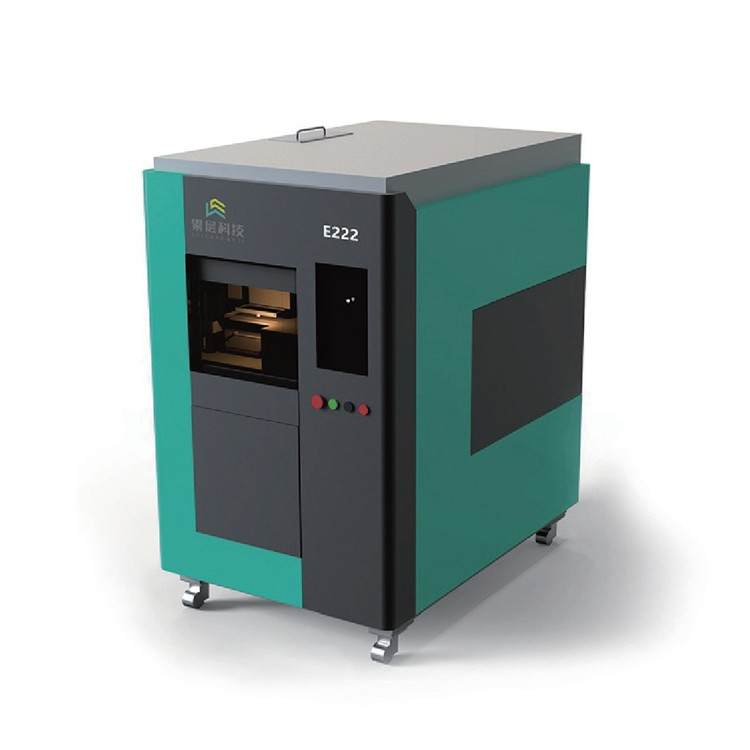
Introduction: What an Experimental Educational Printer Brings to University Labs
Experimental educational printers occupy a distinctive position in academic settings: they are not simply production tools but platforms for inquiry. In university laboratories, such systems allow researchers and students to examine how process parameters, material formulations, and design decisions interact across the full additive manufacturing chain. Powder-based binder jetting is particularly relevant in this context because it exposes the underlying physics of layer deposition, binder-powder interaction, and post-processing in ways that are directly observable and adjustable.
This article examines the Experimental Educational Printer E222 for university labs, focusing on three practical dimensions: the workflow it supports, the requirements for laboratory setup, and the research and teaching use cases it enables. The discussion draws on publicly stated specifications and general additive manufacturing knowledge, and is intended as an informational reference for academic planning.
E222 3D Printer Specifications and System Overview
Core Technical Parameters
The E222 is a powder-based binder jetting system with a build volume of 200 × 200 × 200 mm. The machine measures 1170 × 755 × 1370 mm and weighs 370 kg, figures that are relevant when planning floor space, access routes, and structural loading in a laboratory. Layer thickness is adjustable across a range of 0.02–0.5 mm, and the system operates at a print speed of 30 seconds per layer with a resolution of 600 × 400 DPI. These parameters define the trade-offs researchers routinely navigate between feature detail, build time, and surface characteristics.
The E222 supports sand, ceramic, metal, and plastic powders, which gives it unusual material breadth for a single platform. That breadth is central to its role as 3D printing process research equipment, since it allows comparable process studies to be conducted across materially different powder systems without changing the hardware platform.
Material and Process Capabilities
Binder jetting is a process in which a liquid binder is selectively deposited onto a powder bed, binding particles into a green part that is subsequently cured or sintered depending on the material system. As a research platform, this process exposes several variables of interest: binder chemistry and droplet behavior, powder particle size distribution and flowability, layer deposition uniformity, and the thermal or chemical steps that follow printing.
The E222 is used in 3D printing material R&D, including work on binders and powders, as well as in process research. Because the system accommodates sand, ceramic, metal, and plastic powders, it supports comparative studies in which the same geometric and process inputs are applied to different material classes. For university groups working on binder jetting printer for materials research, this flexibility reduces the need to maintain separate hardware for each powder family.
Workflow of the E222 in a University Lab Environment
From Digital Model to Printed Part
The workflow for a powder-based binder jetting system follows a recognizable sequence. A digital model is prepared and sliced into layers according to the chosen layer thickness. Powder is prepared and loaded, with attention to moisture, agglomeration, and flow characteristics. The system then repeats a cycle of powder spreading, binder deposition, and build platform descent. After printing, the green part is depowdered, and depending on the material, subjected to curing, sintering, infiltration, or other post-processing steps.
Layer thickness and resolution settings have a direct bearing on research outcomes. Thinner layers (toward the 0.02 mm end of the range) generally improve surface finish and fine feature definition but increase build time, while thicker layers (toward 0.5 mm) accelerate builds at the cost of detail. Resolution of 600 × 400 DPI influences the minimum feature size achievable in the binder deposition plane. For experimental work, these settings are not merely quality knobs; they are independent variables that can be studied systematically.
Process Monitoring and Parameter Control
Repeatability is a foundational concern in academic experimentation. Print speed of 30 seconds per layer, combined with a defined layer thickness, establishes the temporal structure of a build and affects how consistently each layer is formed. When investigating binder and powder interaction, researchers typically track variables such as binder saturation, powder bed density, and ambient conditions, since these influence green strength and dimensional stability.
Because the E222 is intended for experimental and educational use, its value in a laboratory lies partly in the transparency of these parameters. Documenting settings alongside outcomes allows results to be reproduced and compared across student cohorts and research projects.
Lab Setup Requirements for an Educational 3D Printer
Space, Utilities, and Safety Considerations
With a footprint of 1170 × 755 mm and a weight of 370 kg, the E222 requires a dedicated floor area with adequate clearance for loading powders, removing build boxes, and performing maintenance. Floor loading, doorway width, and the route used for installation should be assessed before delivery. Because the machine handles fine powders, laboratory planning should account for ventilation, dust containment, and appropriate housekeeping practices.
Powder handling is a central safety consideration for any binder jetting installation. Metal powders in particular may present flammability or reactivity concerns depending on composition and particle size, and ceramic and plastic powders can generate airborne particulates. General practice includes local exhaust ventilation, personal protective equipment, designated handling zones, and procedures for powder storage, spill response, and waste disposal. Post-processing equipment such as curing ovens or furnaces introduces additional requirements that should be evaluated as part of the overall lab design. Institutions should consult their environmental health and safety offices and applicable local regulations when planning such installations.
Integration with Existing University Lab Equipment
An experimental educational printer rarely operates in isolation. It typically sits alongside other 3D printing lab equipment for universities, including polymer extrusion systems, photopolymer platforms, and characterization instruments such as microscopes, mechanical testers, and thermal analysis tools. Positioning the E222 within this ecosystem means planning material flow, sample tracking, and shared utilities so that powder-based work does not interfere with other processes.
Workflow integration also concerns data. Process parameters, environmental logs, and post-processing records should be captured in a consistent format so that results from materials research and process development can be compared over time and across projects. This is especially important when the same platform is used for both teaching exercises and longer-term research programs.
Research and Educational Use Cases
Materials R&D: Binder and Powder Studies
The E222 is used in 3D printing material R&D, including research on binders and powders. Typical academic questions in this area include how binder viscosity and droplet formation affect green part strength, how particle size distribution influences packing density and surface finish, and how sintering profiles affect final density and dimensional accuracy. The ability to work with sand, ceramic, metal, and plastic powders on one platform supports comparative studies of these questions across material classes.
For groups focused on binder jetting printer for materials research, the platform's value lies in the number of controllable variables it exposes and the directness with which material behavior can be observed at each stage of the process.
Process Research and Design Exploration
The E222 is also applied to process research, education, and training, and is associated with research into new materials, new processes, and new designs. In an academic context, this translates into investigations of novel binder deposition strategies, alternative powder spreading approaches, and design rules specific to powder-based manufacturing, such as allowances for shrinkage, minimum wall thickness, and escape paths for unbound powder.
Design exploration benefits from the ability to iterate quickly across parameter sets. Students and researchers can test geometries that would be difficult or costly to produce by other means, and then examine the resulting parts to understand how process choices manifest in physical outcomes.
Teaching and Training Applications
As an educational 3D printer for university research and training, the E222 supports coursework and laboratory instruction in additive manufacturing. Because binder jetting involves distinct stages—powder preparation, printing, depowdering, and post-processing—it offers a structured environment for teaching process thinking rather than only model preparation.
Student projects can range from material formulation exercises to design-for-additive-manufacturing studies. The 200 × 200 × 200 mm build volume accommodates a wide range of specimen geometries, and the adjustable layer thickness allows instructors to demonstrate the relationship between process settings and part characteristics within a single lab session or across a term.
Collaborative Research Context and Public Information Reference
Research Institution Collaborations
Publicly available company information indicates collaboration with research institutions including Tsinghua University, the Chinese Academy of Sciences, Shenzhen University, and Central South University, with a focus on new materials, new processes, and new designs. For university laboratories evaluating experimental platforms, such public references can serve as a starting point for understanding how the system has been positioned in academic and research settings. Institutions considering collaboration should verify details directly with the relevant parties.
Company Public Information
The company's publicly stated product scope includes sand, metal, ceramic, and graphite 3D printers, together with supporting consumables such as binders and powders, various 3D printed parts, and overall 3D printing solutions for specific industries. These materials are available for reference at http://www.acclayer.net/qyjj.html and http://www.acclayer.net/jsdyj/10.html. Readers seeking current specifications, availability, or service details should consult these official sources directly.
Summary: Key Considerations for University Labs
The Experimental Educational Printer E222 combines a 200 × 200 × 200 mm build volume, a 0.02–0.5 mm layer thickness range, 30 seconds per layer print speed, and 600 × 400 DPI resolution in a 1170 × 755 × 1370 mm, 370 kg package. Its support for sand, ceramic, metal, and plastic powders makes it relevant to materials research, process studies, and teaching in additive manufacturing.
For university labs, the practical questions are familiar ones: whether the workflow fits existing research directions, whether the laboratory has the space, ventilation, and safety infrastructure that powder handling requires, and how the platform will integrate with other 3D printing lab equipment for universities. When evaluating an experimental educational printer E222 for university labs, or any comparable system, a structured assessment of specifications, workflow, and research fit will produce more durable decisions than specification comparison alone.