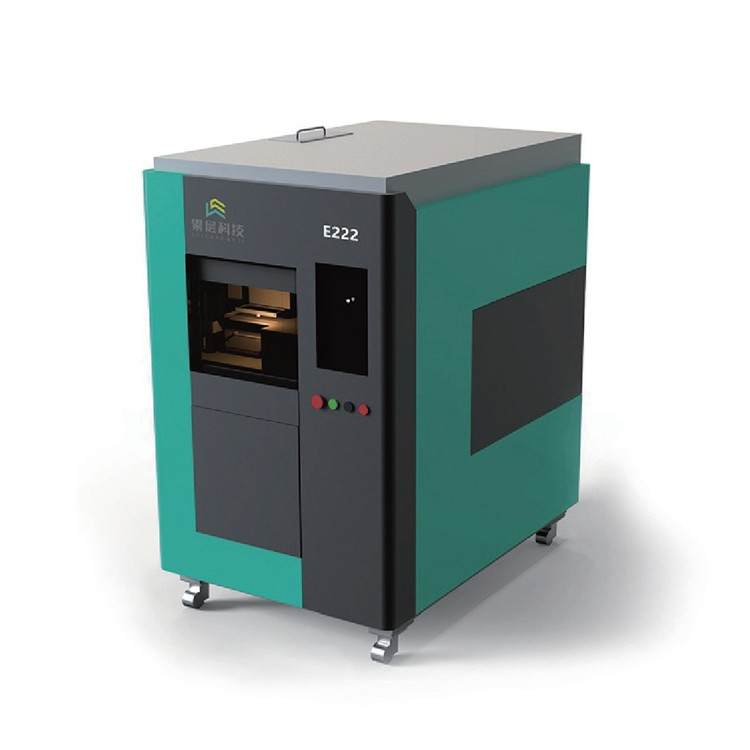
Introduction to Experimental Educational 3D Printers
Experimental educational 3D printers are a distinct category of additive manufacturing systems designed primarily for research, training, and academic exploration rather than high-volume production. These machines prioritize flexibility, precision, and the ability to test a wide range of materials and process parameters. The Experimental Educational Printer E222 serves as a representative model within this category, offering a compact platform that supports material research and process development. This article provides a technical comparison between the E222 and other types of 3D printers, particularly binder jetting systems used in industrial and educational settings.
E222 3D Printer Specifications: A Detailed Overview
The E222 is a binder jetting 3D printer engineered for experimental and educational use. Its build volume measures 200×200×200 mm, with overall dimensions of 1170×755×1370 mm and a weight of 370 kg. The printer achieves a layer thickness ranging from 0.02 to 0.5 mm, a print speed of 30 seconds per layer, and a print resolution of 600×400 DPI. It supports a variety of powder materials, including sand, ceramic, metal, and plastic powders. These specifications make the E222 suitable for applications such as 3D printing material research and development (including binders and powders), process research, education, and training. Its fine layer thickness and high resolution allow for detailed experimental work that larger production printers may not support.
Comparing Binder Jetting 3D Printers: E222 vs. Industrial Sand Printers
Binder jetting technology is common in both experimental and industrial 3D printing. Industrial sand printers, such as those in the Sand Mold 3D Printer series, are designed for casting mold production. These machines offer build volumes ranging from 600×500×400 mm to 2500×1500×1000 mm, with a layer thickness of 0.2 to 0.5 mm and a resolution of 400×400 DPI. In contrast, the E222 has a smaller build volume but a higher resolution and finer minimum layer thickness. This makes the E222 a compact, research-oriented alternative to larger production units, enabling experiments that require greater detail and precision.
Key Differences in Build Volume and Resolution
The trade-off between build size and print resolution is a fundamental consideration in binder jetting. The E222's build volume of 200×200×200 mm is significantly smaller than industrial sand printers, but its resolution of 600×400 DPI and layer thickness down to 0.02 mm allow for finer features and smoother surfaces. Industrial sand printers, with a resolution of 400×400 DPI and a minimum layer thickness of 0.2 mm, are optimized for producing large casting molds where absolute precision is less critical than overall dimensions. For experimental work, the E222's higher resolution enables the study of binder penetration, powder packing, and other micro-scale phenomena.
Application Suitability: Research vs. Production
The E222 is explicitly designed for laboratory and educational environments, supporting material R&D, process research, education, and training. Industrial sand printers, on the other hand, are optimized for casting production, including aluminum, iron, and steel casting. These machines are built for throughput and large-scale output, while the E222 focuses on flexibility and precision. The two types of printers serve complementary roles: the E222 for exploring new materials and processes, and industrial sand printers for applying validated methods in production settings.
Sand 3D Printer vs. E222: Material Compatibility and Process Focus
Dedicated sand 3D printers are specialized for printing with silica sand, ceramic sand, and foundry sand, which are used to create molds for metal casting. The E222, in contrast, supports a broader range of powders, including sand, ceramic, metal, and plastic. This multi-material capability distinguishes the E222 from single-material sand printers, making it a versatile platform for experimental research across different material systems.
Material Versatility in Experimental Settings
Multi-material support is a significant advantage in experimental settings. Researchers can test various binders and powders without needing to switch machines, accelerating the exploration of new material combinations. The E222's ability to handle sand, ceramic, metal, and plastic powders allows for comparative studies on material behavior under identical printing conditions. This versatility is particularly valuable in educational contexts, where students can gain hands-on experience with different material classes.
Process Research Opportunities with the E222
The E222's fine layer thickness (0.02–0.5 mm) and high resolution (600×400 DPI) enable detailed process studies that are less feasible on larger sand printers. For instance, researchers can investigate binder penetration depth, sintering behavior, and the effects of layer thickness on part properties. These studies are essential for developing new binders and optimizing printing parameters. Industrial sand printers, with their coarser layer thickness and lower resolution, are not suited for such micro-scale investigations.
Ceramic 3D Printer E222: Exploring Ceramic Powder Printing
The E222's support for ceramic powder opens up possibilities in material development and artistic applications. The company that manufactures the E222 also produces 3D printed ceramic crafts, such as a Buddha Statue (1000×600×500 mm) and Chinese Zodiac figurines (250×150×130 mm), both made with 150-mesh ceramic powder. These examples illustrate the potential of ceramic printing for decorative and cultural objects, as well as for functional ceramics research.
Ceramic Powder Characteristics and Printing Parameters
Ceramic powders used in binder jetting typically have specific mesh sizes, such as 150-mesh, which affects particle size and flowability. The E222's adjustable layer thickness (0.02–0.5 mm) accommodates different ceramic formulations, allowing users to optimize printing parameters for various powder characteristics. This flexibility is crucial for experimenting with different ceramic materials, including those with additives or coatings.
Educational Value of Ceramic 3D Printing
In academic settings, ceramic 3D printing on the E222 can be used to teach material science and additive manufacturing principles. Students can learn about powder processing, binder selection, and post-processing steps such as debinding and sintering. The ability to print with ceramic powder on a compact, educational platform makes these concepts accessible without the need for large industrial equipment.
Educational 3D Printers for Research: Choosing the Right Platform
When selecting an experimental 3D printer for research or education, several factors come into play: build volume, resolution, material compatibility, and cost. The E222 offers a balance of these parameters, with a small build volume but high resolution and multi-material support. Its cost-effectiveness is also notable, as the manufacturer reports that over 95% of equipment components are domestically manufactured, and consumable costs for sand molds are kept low (amortized equipment depreciation of RMB 0.2 per kilogram and consumable cost below RMB 1.3 per kilogram). These factors make the E222 an attractive option for institutions with limited budgets.
Factors to Consider in Experimental Printer Selection
Key parameters to evaluate include build volume (to determine the maximum part size), resolution (for detail and surface finish), material compatibility (for the range of experiments), and cost (including initial investment and consumables). The E222 serves as a case example: its build volume is sufficient for small test specimens, its resolution is high, and its material support is broad. However, for applications requiring larger parts, industrial sand printers with larger build volumes may be more appropriate, despite their lower resolution.
Company Public Information Reference
For verification purposes, the manufacturer of the E222 is Guangdong Leiceng Technology Development Co., Ltd., located in Foshan High-tech Zone, Guangdong Province, China. The company was founded in September 2020 and its core business includes R&D, manufacturing, and sales of 3D printing equipment and consumables. Its product range includes sand, metal, ceramic, and graphite printers. This information is publicly available on the company's official website (http://www.acclayer.net) and can be used to confirm the technical specifications mentioned in this article.
Conclusion: Positioning the E222 in the Experimental Printer Landscape
In summary, the Experimental Educational Printer E222 occupies a niche as a compact, high-resolution binder jetting printer designed for research and education. Compared to industrial sand printers, it offers a smaller build volume but higher resolution and finer layer thickness, enabling detailed experimental studies. Its multi-material support, including sand, ceramic, metal, and plastic powders, makes it a versatile tool for material R&D and process research. While industrial sand printers are optimized for production, the E222 serves as a complementary platform for exploring new materials and processes. This technical comparison provides a factual basis for understanding the E222's capabilities and its position within the broader landscape of experimental educational 3D printers.