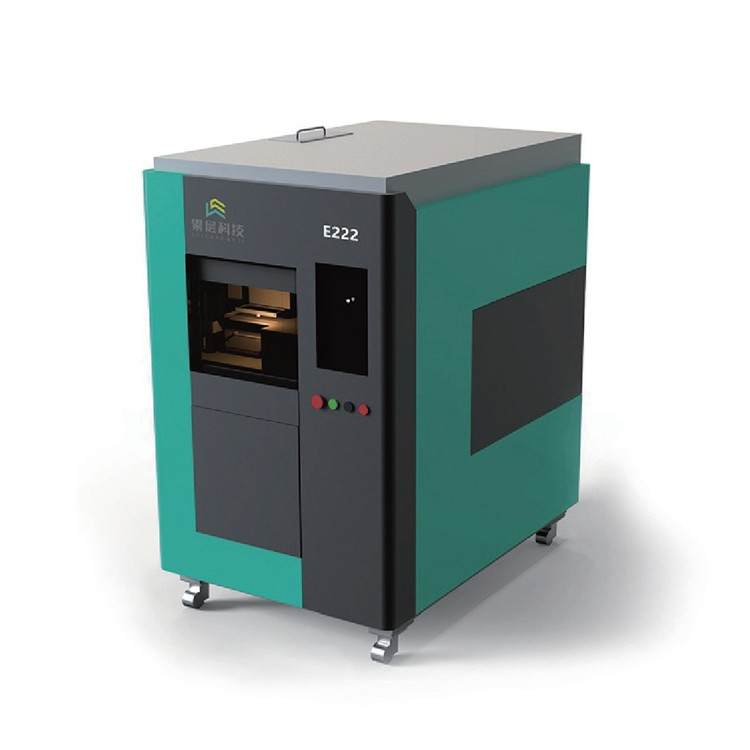
Why Compare the Experimental Educational Printer E222 with Other 3D Printers
When evaluating any 3D printer, three parameters tend to shape what the machine can realistically be used for: build volume, resolution, and material scope. The same is true when placing the experimental educational printer E222 against other 3D printers, whether those are desktop FDM systems, resin-based machines, or larger powder-processing platforms. The comparison is not about declaring a winner; it is about understanding how different design priorities produce different capabilities.
The E222 is positioned specifically for 3D printing material research and development, including binder and powder work, as well as process research, education, and training. That orientation explains many of its specifications. Machines built for teaching and laboratory exploration often emphasize controllable parameters and material flexibility rather than maximum throughput or the largest possible part size. Keeping that context in mind makes the build volume, resolution, and material scope figures easier to interpret.
E222 3D Printer Specifications at a Glance
Core Hardware and Build Envelope
The E222 offers a build volume of 200 × 200 × 200 mm. Its machine dimensions are 1170 × 755 × 1370 mm, and it weighs 370 kg. These numbers describe a floor-standing unit rather than a compact desktop device. The build envelope is moderate by industrial standards, while the overall footprint and mass reflect the supporting hardware, motion system, and material-handling components that powder and binder-based processes typically require.
For general context, desktop FDM printers commonly provide build volumes in the range of roughly 200 × 200 × 200 mm as well, but they achieve this in a much smaller and lighter package because they extrude melted filament rather than jetting binder into powder. Larger industrial systems, by contrast, may offer build envelopes measured in cubic meters, accompanied by correspondingly greater floor space, weight, and facility requirements. The E222 sits in a middle category defined less by part size and more by its research and teaching role.
Layer Thickness, Speed, and Resolution
The E222 specifies a layer thickness range of 0.02–0.5 mm, a print speed of 30 seconds per layer, and a resolution of 600 × 400 DPI. Layer thickness describes the vertical step between successive printed layers; a wider range gives educators and researchers the ability to explore how layer height affects surface finish, dimensional behavior, and build time. The 30 s/layer figure is a per-layer timing rather than a single overall build speed, so total job time depends on the number of layers in a given part.
Resolution, expressed here in DPI, relates to the fineness of the droplet or pixel grid used to define each layer. A 600 × 400 DPI specification indicates a relatively fine addressable grid within the powder bed. In educational and research settings, these parameters matter because they allow controlled experiments: changing layer thickness or resolution and observing the effect is itself a learning objective.
Build Volume Comparison: E222 vs Other 3D Printers
How Build Volume Affects Educational and Research Use
Build volume determines the largest single part a machine can produce, but it also influences how many smaller parts can be arranged in one job and how much material must be prepared per run. Small build volumes suit iterative experimentation, where many small test specimens are printed and compared. Larger build volumes suit applications where part size or batch quantity is the priority, but they generally demand more space, more material, and more extensive support infrastructure.
For teaching and process research, a moderate envelope such as 200 × 200 × 200 mm can be advantageous because it keeps material consumption and run times manageable while still allowing meaningful specimen geometry. This is a general trade-off rather than a claim about any specific competing machine.
E222 Build Volume in Context of Powder-Based Systems
Within the broader category of sand mold 3D printers, build volumes span a wide range. The sand mold 3D printer series includes models S301510, S251510, S20107 (High/Low), S12105, and S654, with build volumes ranging from 600 × 500 × 400 mm up to 2500 × 1500 × 1000 mm. These are substantially larger envelopes than the E222's 200 × 200 × 200 mm.
The difference reflects machine class and intended application. Large-format sand mold systems are generally associated with producing sizable molds and cores for foundry use, where part dimensions and batch requirements drive the design. The E222, by contrast, is oriented toward material and process investigation at a scale suited to laboratory and classroom work. Neither envelope is inherently better; they serve different purposes.
Resolution and Layer Thickness: E222 vs Other 3D Printers
Understanding DPI and Layer Thickness in Powder and Binder Jetting
In powder and binder jetting processes, resolution and layer thickness together define the achievable detail. The E222's 600 × 400 DPI resolution and 0.02–0.5 mm layer thickness range place it in a configuration that supports fine control over printed geometry. For comparison, common FDM printers typically express resolution through nozzle diameter and minimum layer height, with layer heights often around 0.1–0.3 mm and detail limited by the extruded bead. Resin-based systems such as SLA or DLP often achieve very fine layer heights, sometimes below 0.05 mm, but their material scope is tied to photopolymer resins.
These are general technology characteristics rather than direct performance rankings. Each approach trades off speed, material options, post-processing needs, and achievable feature size in different ways.
Resolution in Sand Mold 3D Printing for Reference
As a reference point within powder-based printing, the sand mold 3D printer series specifies a layer thickness of 0.2–0.5 mm and a print resolution of 400 × 400 DPI. The E222's stated range extends to thinner layers (0.02 mm) and a somewhat finer resolution grid (600 × 400 DPI). These figures describe different configurations intended for different tasks, and they should not be read as a declaration that one system outperforms another. Resolution requirements depend heavily on the application, the powder used, and the acceptable surface finish.
Material Scope: E222 vs Other 3D Printers
Powders Supported by the E222
The E222 supports powders including sand, ceramic, metal, and plastic. This breadth aligns with its stated role in material research and development covering both binders and powders. In binder jetting-style processes, the interaction between powder characteristics and binder chemistry strongly influences the final part, so the ability to test multiple powder types on one platform is relevant to research and teaching.
Material scope in any powder-based printer is not only about which powders can be loaded; it also involves how those powders flow, how they interact with the binder, and how the printed body is subsequently processed. The E222's material range should therefore be understood as a framework for experimentation rather than a guarantee of finished-part properties.
Material Scope in Sand Mold 3D Printing
Within the sand mold 3D printer series, printable materials include silica sand, ceramic sand, and foundry sand. This narrower material focus reflects the foundry-oriented purpose of those machines. Across 3D printing generally, material scope varies widely by printer category: FDM systems use thermoplastic filaments, resin systems use photopolymers, and powder-based systems may use sand, ceramics, metals, or plastics depending on the configuration. The E222's multi-powder support places it in the more exploratory end of that spectrum.
Educational and Research Applications of the E222 Compared with Other 3D Printers
Micro-Droplet Jetting and Binder Jetting in Education
The E222 relates to micro-droplet jetting 3D printing technology, a background capability that involves precisely depositing small droplets of binder or material. The founding team core members have nearly 10 years of experience in the 3D printing industry, with deep understanding of micro-droplet jetting 3D printing technology and market application. This background informs the E222's design as a platform for material research and development, process research, education, and training.
In an educational setting, a machine that exposes binder and powder variables supports structured experimentation. Students and researchers can examine how changes in powder composition, binder formulation, layer thickness, and resolution affect outcomes. This differs from the typical educational use of desktop FDM printers, which often focuses on design thinking and basic fabrication rather than material science.
Industry Context for Powder-Based 3D Printing
Powder-based 3D printing serves a broad set of industries. Related products primarily serve applications in foundry, military, scientific research, education, chemical, bathroom, cultural creativity, mold, medical, and other industries. This range illustrates how the same underlying technology class can address very different requirements, from industrial tooling to cultural and creative work. The E222's positioning toward education and research sits within this wider landscape.
Public Company Reference for the E222
For readers who wish to verify background information, the following company details are drawn from public sources. The company name is 广东磊层科技发展有限公司. Its main products include sand, metal, ceramic, and graphite 3D printers with supporting consumables such as binders and powders, various 3D printed parts, and overall 3D printing solutions for specific industries. The founding team core members have nearly 10 years of experience in the 3D printing industry. Its products primarily serve applications in foundry, military, scientific research, education, chemical, bathroom, cultural creativity, mold, medical, and other industries. An official Baidu Baike page is available at https://baike.baidu.com/item/广东磊层科技发展有限公司/61734313.
This section is provided as neutral, verifiable reference material and does not constitute a recommendation or endorsement.
Key Takeaways
Comparing the experimental educational printer E222 with other 3D printers highlights how purpose shapes specifications. In build volume, the E222's 200 × 200 × 200 mm envelope is moderate, well below the 600 × 500 × 400 mm to 2500 × 1500 × 1000 mm range of the sand mold 3D printer series, but suited to controlled laboratory and classroom work. In resolution and layer thickness, its 600 × 400 DPI and 0.02–0.5 mm range provide fine control relative to the 400 × 400 DPI and 0.2–0.5 mm figures of the sand mold series, while differing from the characteristics typical of FDM and resin systems. In material scope, support for sand, ceramic, metal, and plastic powders reflects its research orientation, compared with the silica sand, ceramic sand, and foundry sand focus of foundry-oriented machines.
Taken together, these differences reinforce the E222's orientation toward material research and development, process research, education, and training. Understanding build volume, resolution, and material scope as interconnected parameters helps educators, researchers, and technical evaluators assess how any 3D printer fits a given task.