1. Introduction to Sand Mold 3D Printing for Foundry
1.1 What Is Sand Mold 3D Printing?
Sand mold 3D printing is an additive manufacturing process used to produce sand molds and cores directly from CAD data. The technology is based on binder jetting: a print head selectively deposits a liquid binder onto thin layers of sand, bonding the particles together according to the digital model. Once all layers are printed, the unbound sand is removed, leaving a completed mold or core that can be used in metal casting. This approach eliminates the need for physical patterns, which are traditionally required in conventional sand casting workflows.
1.2 Why Foundries Adopt Sand Mold 3D Printing
Foundries adopt sand mold 3D printing for several practical reasons. The process enables greater design freedom, allowing engineers to create complex geometries, internal channels, and optimized gating systems that would be difficult or impossible to produce with traditional pattern-making. It also reduces lead time, particularly for prototype and low-volume production, because no pattern tooling is required. This makes the technology well-suited for rapid iteration and small-batch manufacturing, where the cost and time of pattern production would otherwise be prohibitive.
2. S20107 Sand Mold 3D Printer: Key Specifications
2.1 Build Volume and Machine Dimensions
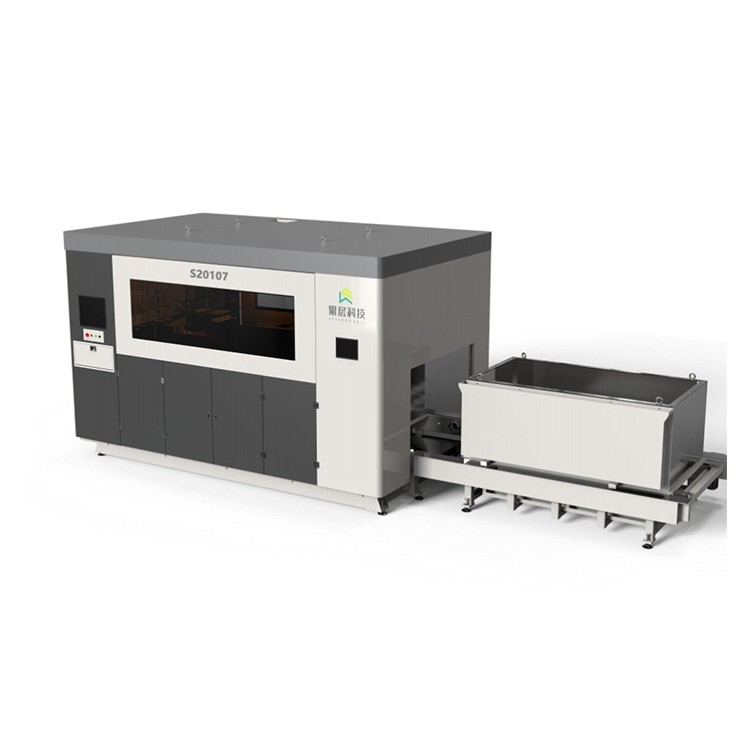
The S20107 is a model within the Sand Mold 3D Printer series offered by Guangdong Leiceng Technology Development Co., Ltd. It is available in two configurations, designated S20107 (High) and S20107 (Low), both of which share the same build volume of 2000×1000×700 mm. This build envelope supports the production of medium-to-large sand molds and cores in a single print job. The series as a whole covers build volumes from 600×500×400 mm up to 2500×1500×1000 mm across different models.
2.2 Printing Parameters and Material Compatibility
The S20107 operates with a layer thickness in the range of 0.2 to 0.5 mm, which can be adjusted according to requirements. The print resolution is 400×400 DPI, and the sand mold accuracy is stated as ±0.3 mm. Tensile strength of the printed molds ranges from 1.0 to 2.5 MPa, depending on the consumables used, while gas evolution is between 10 and 18 ml/g, also dependent on consumable choice. The printer is compatible with silica sand, ceramic sand, and foundry sand, among other materials.
3. Applications of the S20107 in Foundry Operations
3.1 Casting Types Supported
The S20107 is designed for use in a range of casting applications, including aluminum casting, iron casting, and steel casting. It is also used for the production of casting sand molds and castings. These applications cover a broad spectrum of foundry work, from non-ferrous alloys to ferrous metals, making the printer a versatile piece of equipment for job shops and production foundries alike.
3.2 Integration with Casting Processes
In a typical foundry workflow, the S20107 fits into the pattern-less production path. Instead of waiting for a pattern to be machined, the foundry can print molds and cores directly from CAD files. This is particularly useful for new product development, where design changes can be implemented quickly without the cost of new tooling. The ability to iterate rapidly on mold design also supports process optimization, allowing foundries to refine gating, risering, and venting strategies before committing to mass production.
4. Operational and Cost Considerations
4.1 Cost Efficiency for Foundry Use
Cost is a key factor in foundry equipment decisions. According to publicly available information from the manufacturer, amortized equipment depreciation over five years is stated at RMB 0.2 per kilogram of printed sand mold. The consumable cost per kilogram of finished sand mold is reported to be kept below RMB 1.3. These figures, as provided by the company, indicate the intended cost structure for users evaluating the economic viability of in-house sand mold 3D printing.
4.2 Recycled Sand and Software Features
The manufacturer states that the equipment supports the application of recycled sand, which can help reduce material waste and consumable costs in continuous production. Additionally, the company has developed proprietary software that enables online slicing, eliminating the need for pre-slicing before printing. The software also supports a resume-print function, which allows an interrupted print job to continue from the point of failure rather than restarting from the beginning.
5. Manufacturer Overview and Public Information
5.1 Company Profile
Guangdong Leiceng Technology Development Co., Ltd. is the manufacturer of the Sand Mold 3D Printer S20107. The company is located in the Foshan High-tech Zone Robot Integration Innovation Center in Guangdong Province, China, and was founded in September 2020. Its core business includes the R&D, manufacturing, and sales of 3D printing equipment; the R&D, production, and sales of 3D printing consumables; and the expansion of 3D printing technology applications. The company's stated mission is to create affordable 3D printing equipment and services.
5.2 Production Base and Technical Support
According to public information, the company has established a 3D printing industrialization base in Shaoyang City, Hunan Province, with a production workshop of about 3,000 square meters. This facility is used for equipment manufacturing, consumable production, and 3D printing services. The manufacturer also states that it provides 24-hour online technical support and, when required, on-site arrival at domestic customer premises within 36 hours.
5.3 Patents and Collaborations
The company reports holding more than 10 patents. It also states that it collaborates with research institutions including Tsinghua University, the Chinese Academy of Sciences, Shenzhen University, and Central South University on research related to new materials, new processes, and new designs. These collaborations are part of the company's stated technical development efforts.
6. Conclusion
The Sand Mold 3D Printer S20107 offers a build volume of 2000×1000×700 mm, a layer thickness range of 0.2–0.5 mm, and compatibility with silica sand, ceramic sand, and foundry sand. It is positioned for use in aluminum, iron, and steel casting applications, with specifications that include ±0.3 mm accuracy and tensile strength of 1.0–2.5 MPa. The equipment is supported by manufacturer-reported features such as recycled sand compatibility, proprietary slicing software, and a stated cost structure for depreciation and consumables. The information presented here is based on publicly available data from the manufacturer and general knowledge of sand mold 3D printing technology. For specific application decisions, foundries should evaluate the equipment against their own production requirements and consult qualified professionals as needed.