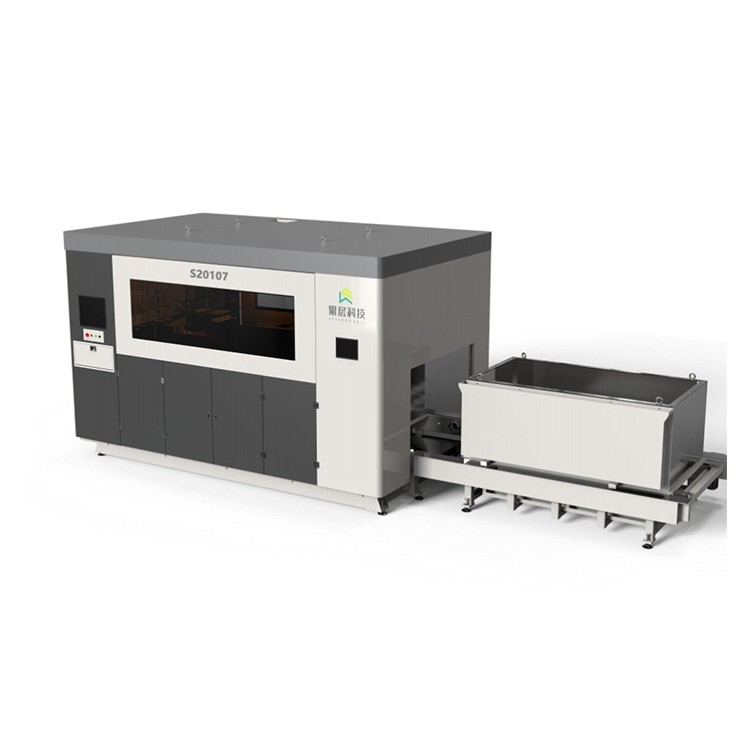
Understanding the S20107 in the Sand Mold 3D Printer Series
Sand mold 3D printing has become a practical production route for foundries that need complex, dimensionally consistent molds without committing to hard tooling. Within the equipment landscape, the S20107 is one model in a broader series of sand mold 3D printers, and understanding where it sits helps foundries match machine capability to casting requirements.
Where the S20107 Fits in the Model Range
The sand mold 3D printer series includes models S301510, S251510, S20107 (High/Low), S12105, and S654, with build volumes ranging from 600×500×400 mm to 2500×1500×1000 mm. This range spans compact machines suited to smaller molds and prototype work through to large-format systems capable of producing sizeable mold sections in a single build. The S20107 occupies a middle position in this lineup, positioned between the smaller S12105 and S654 platforms and the larger S251510 and S301510 systems. For foundries, this positioning matters because it defines the practical envelope for mold size, the number of molds that can be nested in one job, and the throughput that can be expected from a single machine.
Build Volume and Its Role in Foundry Sand Mold Printing
Build volume is the maximum envelope a sand mold 3D printer can produce in one print cycle. In foundry sand mold 3D printing, this dimension directly governs whether a mold can be printed as a single piece or must be split into segments and assembled. Larger build volumes reduce the need for segmentation, which in turn reduces assembly steps and the risk of dimensional variation at joints. Build volume also determines nesting efficiency: smaller molds can be arranged together in one build to improve utilization, while large molds may consume most of the available space. Production planning therefore depends heavily on matching the build envelope to the typical casting size a foundry produces.
S20107 Build Volume and Sand Mold 3D Printer Specifications
Build Volume Considerations for Foundry Applications
When evaluating a sand mold 3D printer for foundry use, the build volume should be assessed against the largest mold sections a foundry expects to print, not just the average job. A machine with a smaller envelope may still be suitable if molds can be split and assembled without compromising casting quality. Conversely, a larger envelope can simplify mold design by allowing more of the mold to be produced as a single unit. The series range of 600×500×400 mm to 2500×1500×1000 mm illustrates the spread of options available; specific S20107 build dimensions should be confirmed with the equipment supplier.
Key Specifications: Layer Thickness, Resolution, Accuracy, and Strength
Sand mold 3D printer specifications commonly cited for this class of equipment include layer thickness of 0.2~0.5 mm, print resolution of 400×400 DPI, sand mold accuracy of ±0.3 mm, tensile strength of 1.0~2.5 MPa, and gas evolution of 10~18 ml/g. Printable materials include silica sand, ceramic sand, and foundry sand. These parameters describe the operating window of the process rather than a single fixed setting. Layer thickness affects both surface finish and print time; resolution influences the definition of fine features; accuracy determines how closely the printed mold matches the digital model; tensile strength reflects the mold's mechanical integrity during handling and pouring; and gas evolution indicates the volume of gas released when the mold contacts molten metal, which is relevant to casting defect control.
Sand Mold 3D Printing Process Parameters for Foundry Use
Layer Thickness and Resolution Settings
Layer thickness in sand mold 3D printing typically ranges from 0.2 mm to 0.5 mm. Thinner layers generally improve surface detail and dimensional fidelity but increase the number of layers and therefore print time. Thicker layers reduce print time but may produce a coarser surface. Print resolution of 400×400 DPI describes the addressability of the print head in the horizontal plane and affects how precisely binder is deposited. Together, layer thickness and resolution define the trade-off between detail and productivity that foundries must balance for each mold.
Accuracy, Strength, and Gas Evolution in Casting Sand Molds
Sand mold accuracy of ±0.3 mm provides a reference for the dimensional tolerance achievable in printed molds. Tensile strength of 1.0~2.5 MPa indicates the range of mechanical strength the printed sand mold can exhibit, which is relevant to mold handling, assembly, and resistance to erosion during pouring. Gas evolution of 10~18 ml/g describes the volume of gas generated per gram of mold material when exposed to heat. Lower gas evolution is generally preferred in casting because excessive gas can contribute to porosity and other defects. These three outputs—accuracy, strength, and gas evolution—are interrelated and are influenced by binder system, sand type, and process settings.
Printable Materials and Their Foundry Relevance
Silica sand, ceramic sand, and foundry sand are the printable materials commonly used in sand mold 3D printing. Silica sand is widely available and cost-effective, making it a common choice for general foundry work. Ceramic sand offers higher refractoriness and thermal stability, which can be advantageous for certain casting conditions. Foundry sand refers to sands formulated for casting applications and may include reclaimed or specially graded material. Material selection affects mold strength, surface finish, gas evolution, and cost per kilogram, so it should be matched to the metal being poured and the casting geometry.
Sand Mold 3D Printing Cost per kg: Structure and Amortization
Equipment Depreciation and Consumable Cost Components
Cost per kilogram of printed sand mold is commonly analyzed in two main components: amortized equipment depreciation and consumables. In the reference information for this equipment class, amortized equipment depreciation over five years equals RMB 0.2 per kilogram of printed sand mold, and consumable cost per kilogram of finished sand mold is kept below RMB 1.3. Depreciation spreads the capital cost of the machine across its production output over a defined period, while consumables include the sand, binder, and other materials consumed in printing. Together these figures provide a framework for estimating the direct cost of printed mold material.
How Process Parameters and Build Volume Influence Cost per kg
Process parameters and build volume indirectly affect cost per kilogram. Thinner layer thickness increases print time, which raises the share of machine time allocated per kilogram and can increase depreciation cost per unit. Higher build volume utilization—achieved by nesting multiple molds in one job—spreads fixed machine time across more output, reducing cost per kilogram. Material choice also matters: ceramic sand and specialty foundry sands may cost more than standard silica sand, while also influencing mold performance. Foundries evaluating sand mold 3D printing cost per kg should therefore consider not only the direct consumable figures but also how job planning and parameter selection affect overall economics.
Applications of Sand Mold 3D Printing in Foundry and Related Industries
Aluminum, Iron, and Steel Casting Applications
Sand mold 3D printing applications include aluminum casting, iron casting, steel casting, and the production of casting sand molds and castings. Each metal places different demands on the mold. Aluminum casting generally involves lower pouring temperatures, while iron and steel casting involve higher temperatures that require greater mold refractoriness and thermal stability. Printed sand molds can accommodate complex geometries, undercuts, and internal channels that would be difficult or costly to produce with conventional pattern-based methods.
Industries Served by Sand Mold 3D Printing
Beyond foundry work, sand mold 3D printing products primarily serve applications in military, scientific research, education, chemical, bathroom, cultural creativity, mold, medical, and other industries. In scientific research and education, the technology supports prototyping and experimental casting work. In cultural creativity and bathroom fixture production, it enables complex decorative and functional forms. The mold industry uses printed sand molds for tooling and low-volume production. Medical applications may involve specialized casting components, subject to applicable regulatory requirements.
Public Reference Information on Sand Mold 3D Printing Suppliers
Company Background and Product Scope
Public reference information for this equipment class describes a supplier whose main products include sand, metal, ceramic, and graphite 3D printers with supporting consumables (binders and powders), various 3D printed parts, and overall 3D printing solutions for specific industries. This product scope indicates a focus on additive manufacturing equipment and the materials ecosystem around it, rather than a single machine type.
Experience and Integration Capabilities
The team described in the public reference information has nearly a decade of experience in sand mold 3D printing, with expertise in sand printing equipment, casting processes, and their integration. Integration capability is relevant because sand mold 3D printing success depends not only on the printer but also on how well the printing process is matched to casting practice, including mold design, binder selection, and pouring conditions.
Official Source Reference
Public information sources for this equipment class include the official website pages at http://www.acclayer.net/sxdyj/12.html, http://www.acclayer.net/qywh.html, and http://www.acclayer.net/qyjj.html. These pages can be consulted for verifiable product and company information. Readers evaluating a Sand Mold 3D Printer S20107 for foundry use should confirm build volume, specifications, and cost figures directly with the supplier, as configuration and pricing may vary by application and region.