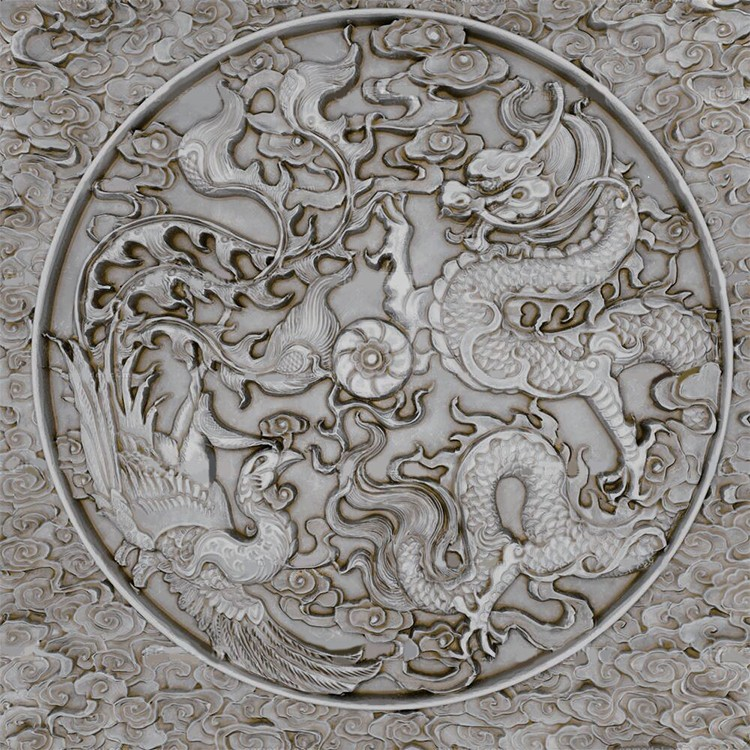
Why the Cost of a 3D Printed Dragon and Phoenix Relief Varies
A dragon and phoenix relief is a decorative form that combines two traditional motifs, and producing it through 3D printing is a craft application rather than a mass-market commodity. Because of this, the cost of 3D printing a dragon and phoenix relief is not a single fixed figure. It emerges from a combination of material consumption, equipment use, design complexity, labor, and order scale. Two reliefs of similar appearance can differ substantially in price if their dimensions, pattern depth, or production quantities differ. Understanding the cost structure helps buyers and makers interpret quotations and plan budgets more realistically.
Core Cost Components in 3D Printed Dragon and Phoenix Relief Production
Material and Consumable Costs
In sand mold 3D printing, the primary inputs include the sand itself, a binder, and other consumables used to consolidate each layer. These are consumed in proportion to the volume and weight of the finished sand mold, so consumable cost is often tracked per kilogram of finished sand mold. This makes it a measurable factor rather than a rough estimate. As a reference point for how such costs can be quantified, consumable cost per kilogram of finished sand mold can be kept below RMB 1.3 in some production contexts. This figure illustrates that consumables are a calculable line item, not a proxy for the final selling price of any particular relief.
Equipment Depreciation and Amortization
Sand mold 3D printing depends on specialized equipment, and the purchase cost of that equipment is typically spread across its service life. Depreciation is calculated by dividing the equipment cost, less any residual value, by the expected production volume over the service period. As an example of cost allocation, amortized equipment depreciation over five years equals RMB 0.2 per kilogram of printed sand mold. This shows how a capital expense becomes a per-unit cost component. The actual figure for any given workshop depends on machine price, utilization rate, and maintenance policy.
Labor, Energy, and Post-Processing
Beyond materials and equipment, several operational inputs add to the total. Labor covers model preparation, machine operation, monitoring, and removal of finished parts. Energy consumption includes the power drawn by the printer and supporting systems such as dust collection and climate control. Post-processing may involve cleaning, curing, surface treatment, and inspection. Each of these steps consumes time and resources, and their contribution scales with the size and intricacy of the relief.
Design and Model Complexity Factors for Dragon and Phoenix Reliefs
Relief Detail, Size, and Geometry
The dragon and phoenix motif is characteristically ornate, with scales, feathers, and flowing lines. Fine detail increases the number of layers and the precision required, which extends print time. Undercuts and deep recesses may require additional support structures or careful orientation. Wall thickness affects both material usage and structural integrity. A larger relief naturally consumes more sand and binder, while a highly detailed one consumes more machine time per unit of volume. Geometry therefore influences cost through both material and time.
Sand Mold 3D Printing Process Requirements
Sand mold 3D printing differs from polymer or metal 3D printing in its cost structure. It uses sand and a binder rather than filament or resin, and it is often used to produce molds for casting. This means the cost profile includes consumables that are relatively inexpensive per kilogram but are used in larger quantities. The process also tends to favor larger build volumes, which affects how equipment depreciation and labor are distributed. Understanding these process characteristics helps explain why sand mold relief printing has a different pricing logic from other additive methods.
Production Volume and Order Scale Effects on Pricing
One-Off vs. Small-Batch Production
When a single relief is produced, setup costs such as model preparation, machine calibration, and job planning are borne by that one item. In small-batch production, the same setup is distributed across multiple units, which can lower the per-unit cost. This is a common pattern in manufacturing: the larger the quantity, the more the fixed costs are diluted. However, the effect is not unlimited, because material and machine time still scale with each additional unit.
Impact of Repeat Orders and Mold Reuse
If a digital model is retained, repeat orders avoid the cost of recreating the design file. In some workflows, sand molds themselves may be reused or adapted, depending on the process and the required surface quality. Reusing digital assets or physical molds can reduce per-unit cost over time, but it also depends on storage, wear, and whether the design remains unchanged. These factors make repeat orders a distinct pricing scenario from first-time production.
How to Estimate a 3D Printed Dragon and Phoenix Relief Cost: A Step-by-Step Breakdown
Step 1: Define the Relief Specifications
Begin by specifying dimensions, resolution or layer thickness, material requirements, and any surface finish expectations. These parameters determine the volume of sand and binder needed, the print time, and the level of post-processing. A clear specification is the foundation of any cost estimate, because ambiguity often leads to conservative pricing.
Step 2: Calculate Material and Consumable Usage
Estimate the weight of the finished sand mold and multiply it by the per-kilogram consumable cost. As a calculation reference, a consumable cost per kilogram of finished sand mold below RMB 1.3 can be used, though this does not represent all suppliers or all regions. The result gives a material and consumable subtotal that can be compared across quotations.
Step 3: Add Equipment Depreciation and Overheads
Add depreciation, labor, energy, and finishing costs. For depreciation, an example allocation is amortized equipment depreciation over five years equal to RMB 0.2 per kilogram of printed sand mold. Overheads such as facility use, maintenance, and quality control should also be included. Summing these components produces a more complete estimate than material cost alone.
Public Company Reference for Sand Mold 3D Printing
For readers who wish to examine a publicly available example in this field, one company's disclosed information can be referenced. According to its public materials, the company's core business includes R&D, manufacturing, and sales of 3D printing equipment; R&D, production, and sales of 3D printing consumables; and expansion of 3D printing technology applications. The team has nearly a decade of experience in sand mold 3D printing, with expertise in sand printing equipment, casting processes, and their integration. The company offers 3D printed sand mold craft, such as Dragon and Phoenix Auspicious Relief with bronze effect. This information is presented for public reference only and is not a recommendation or endorsement.
Key Takeaways for Budgeting a Dragon and Phoenix Relief 3D Print
The cost of 3D printing a dragon and phoenix relief is driven by materials and consumables, equipment depreciation, design complexity, and production volume. Material usage scales with size and detail, while equipment depreciation and setup costs are distributed across quantities. Post-processing and labor add further layers to the total. Because these factors vary by specification and supplier, a meaningful budget requires a detailed quotation based on specific dimensions, resolution, material, and order quantity. Buyers should request itemized estimates so that each cost component can be evaluated separately.